
The Gnostic Self and Its Double
Reading Grotowski as a means of going beyond Theatre

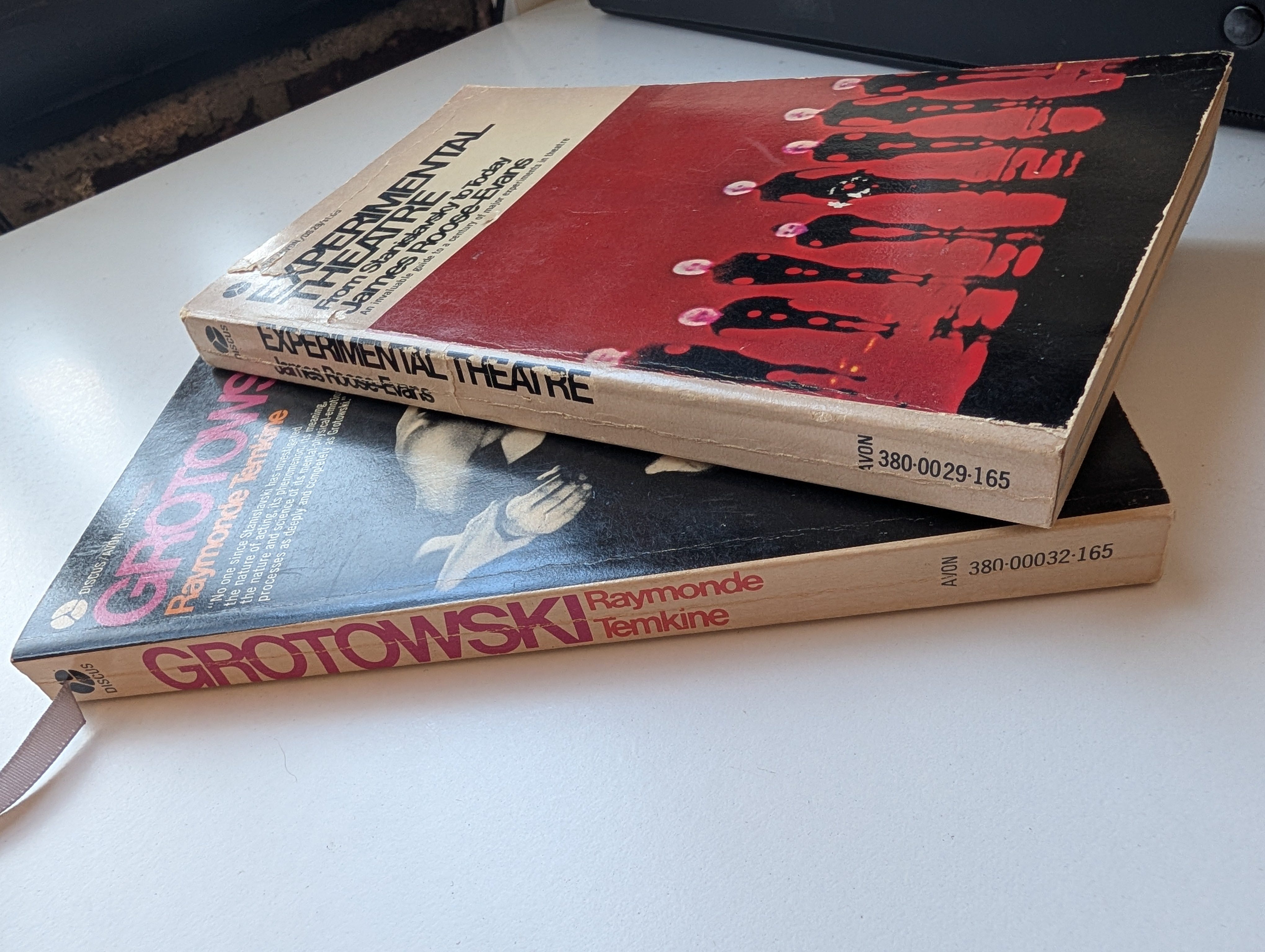
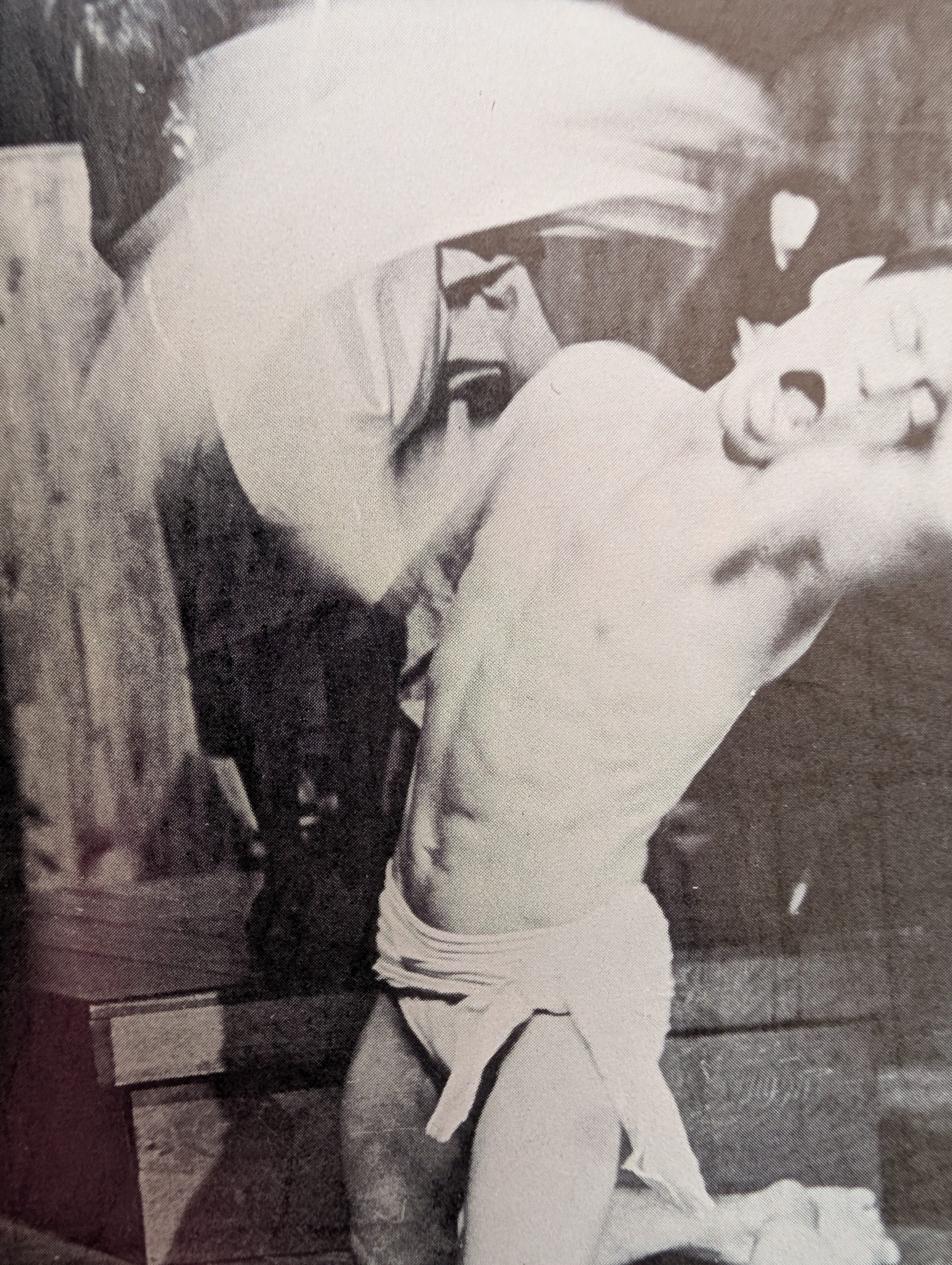
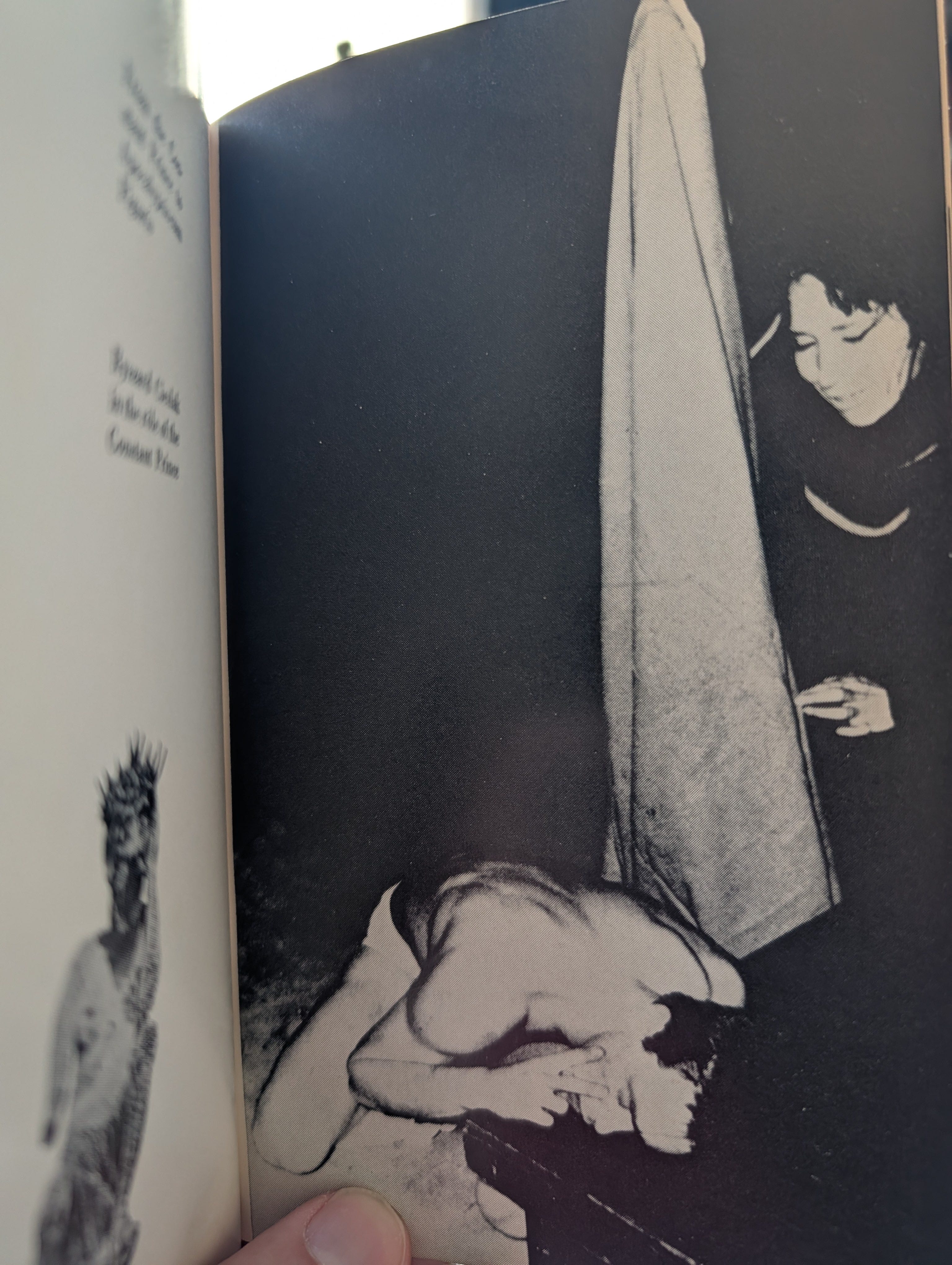
My first encounter with Grotowski was via the stunning, stark photographs of Ryszard Cieslak in The Constant Prince as featured in James Roose-Evans’ quintessential 1971 tome, Experimental Theatre: From Stanislavsky to Today. The way Cieslak’s body, even in still photographs divorced from any context I was aware of, was able to carry such intensity, such a heightened level of affect, dovetailed specifically with what were the early impetus I was trying to explore as I had begun moving into corporeal movement myself (first with yoga, then through acrobatic disciplines). The research continued through my reading of Raymonde Temkine’s Grotowski, another early recounting from the heyday of Grotowski’s global notoriety brought about thru his Theatre of Productions phase.
These initial engagements also opened up a contained which allowed me to consider the experimental film I was engaging with simultaneously to my physical research, specifically the “cinema of the body” movement, consisting loosely of filmmakers like Thomadaki/Klonaris, Teo Hernandez, and many others (something that, to this day, I still hope to dedicate an issue of my R[a/u]pture film zine to). An email to Thomadaki herself revealed that the backbone to a favorite film of mine—Chutes, desert, Syn.—was an interest in Grotowski’s physical training. The more I was able to elaborate this work as a sort of rosetta stone to what I though I was truly looking to do with movement, the deeper my obsession grew. And, as is always the case, I began to voraciously read everything I could on Grotowski—and there’s quite a bit, all things considered.
This opening up occured shortly before the pandemic, so the bulk of my engagement happened during a span of time where I had nothing but time. Reading about the work was a way to insist upon a stringent corporeality without needing to train even more than I already was, a way that I could exercise the thought of corporeality without needing to further exhaust my tired body.
However, what I grew to discover was that what precisely it was that Grotowski was doing was a world of difference away from what many people—both scholars and practitioners alike—understand Grotowski’s work to be.
I have written before about how I generally find myself specifically interested in cultural production that, to not put too fine of a point on it, exceeds the medium that it is positioned within. I wrote about this nearly two years ago, explicitly in relationship to both Butoh,realms of French poetry/ecriture, and fashion itself, but this of course extends outwards. Generally, the value of much of this work is in the fact that it is “fashion as a means to move beyond fashion” (Poell’s oeuvre), “poetry as a means to move beyond poetry” (the most obvious example being Bataille himself but extending to other post-Batalliean “poets”), and here, the specific topic at hands, “theatre as a means to move beyond theatre,” the work of Grotowski.
Americans involved in theater have a tendency to at least be very much aware of Grotowski’s theatre of production phase, maybe a bit of the active culture work if they’ve seen My Dinner with Andre, but the interest in anything that may or may not have happened past 1980 isn’t there. I’ve been very confused with academics try to very confidently tell me something about Grotowski and I realize that their knowledge isn’t coming from Grotowski’s work itself, but rather through the second-hand currents that ended up floating through New York pedagogy, taking some of the roots of Grotowski’s thought/work and turning in into an explicity methodology.
Ultimately I think the best reading(s) of what it was precisely that Grotowski was doing come from more recent scholarship spear-headed by Antonio Attisani and his essay from TDR “Acta Gnosis.” This is to say, that some art starting to recognize Grotowski’s project as one of gnosis. This is not an inherently heremetic declaration, but rather points to the insistence that the work on the self as project (initially developed for the communion of theater) is to create a man of knowledge, “a Gnostic journey towards the Self through anamnesis.” Important here is the fact that Grotowski constantly affirms the idea that knowledge is a matter of action, and not just thought.
The thesis of Leszek Kolankiewicsz’s recent essay “Gnostic Anointed as College Chair” (2024) points to an excerpt from a lecture by Gilles Quispel:
In the final analysis gnosis is anthropology: man stands at the centre of gnostic interests. The myths and doctrines of gonsis describe man’s origin and essence so that he knows what path he should follow, namely, the path leading to the Self, a path of salvation. The gnostic myth is intended to be but an anamnesis. (Quispel, 1951)
In my own understanding, I think this is an arguably smart read of the ‘project,’ so to speak, but I do question it, as contrary to this, Attisani (in “Acta Gnosis”) insists upon an anti-anthropocentric “third way,” — even pointing to Osinski’s statement that Grotowski desired to “overcome an anthropocentrism entirely foreign to him.” The insistence, Attisani says, is to overcome the centrality of the human being. This paradox (we could say, to carry on how I’ve stated things above: working on the self as a means to overcome the insistence of the self) is inherent to the idea even historically “Gnosis [is] a search for salvation through knowledge and experience.” We must point to the idea that a “Gnosis… beyond humanism and anthropology [insists that here] ‘beyond’ is to be understond in the sense of Aufhebung (‘to go beyond’ but also ‘to bring to fulfillment’).”
Inherently, this gnostic quest always a space back to the work of Georges Bataille, whom shares with Grotowski the idea that inner experience (as an action) can take us beyond — for Bataille this gnoses is sovereign experience of the impossible and a certain animality, a continuity: “the animal is in the world like water in water.” The same paradox inherent so much religiosity and mysticism: the need for the work on the self to take one beyond the self.
This tension (& insistence) is clearly at odds with the detritus of the Human Potential Movement and its overlap with the post-Active Culture experiments of the 70s and early 80s (refer here to My Dinner with Andre); it removes the myth of the self-made genius, an American and explicitly NYC-centric positionality predicated upon the late capitalist impulse rather than any desire for immanence. Even the briefest peak into the current wellness industry should clarify the level of distance here.
With all this said; I write this merely to re-enter my own written praxis with more of Grotowski’s presence. My initial engagement ended up fizzling out when I accidentally deleted a large file of notes I had taken through reading print copies of virtually everything that was available translated into English. I was also starting to get burnt out in my incapacity to apply any of what I was reading to an active practice that would lead to a performative insistence: retrospecitively, it is obvious that thi was me trying to push a square peg into a round whole, and the entireity of what Grotowski himself realized on his journey.
The recently re-readings of certain key essays (as I also search for more recent scholarship) have proved rewarding to the space I am in now, which I think allows me to maybe state for the first time that my interest in performance is really an interest in performance so as to move beyond performance, and that paradox opens up a new consideration of what exactly is that all of this work I have been doing for the last 10-15 years is actually leading up to.
Note: yes, upon hitting “post” there was a typo in the title, but thanks to the unsolicited person in my comments pointing it out, I've been able to correct that. The rest of the typos in this article (and I'm sure there are many, I've literally pointed out before that for most of these blogs I type things out and hit “post” without re-reading) will be fixed, or not, at some point in the future.
It is double.