
PURE/IMPURE: BASE MATERIALISM AND THE HIDDEN BODY
An investigation into a singular image from an obscure season of cult designer Carol Christian Poell

“The big toe is the most human part of the human body, in the sense that no other element of this body is as differentiated from the corresponding element of the anthropoid ape (chimpanzee, gorilla, orangutan, or gibbon). This is due to the fact that the ape is tree dwelling, whereas man moves on the earth without clinging to branches, having himself become a tree, in other words raising himself straight up in the air like a tree, and all the more beautiful for the correctness of his erection. In addition, the function of the human foot consists in giving a firm foundation to the erection of which man is so proud (the big toe, ceasing to grasp branches, is applied to the ground on the same plane as the other toes).
But whatever the role played in the erection by his foot, man, who has a light head, in other words a head raised to the heavens and heavenly things, sees it as spit, on the pretext that he has this foot in the mud.” (Georges Bataille, “The Big Toe”)
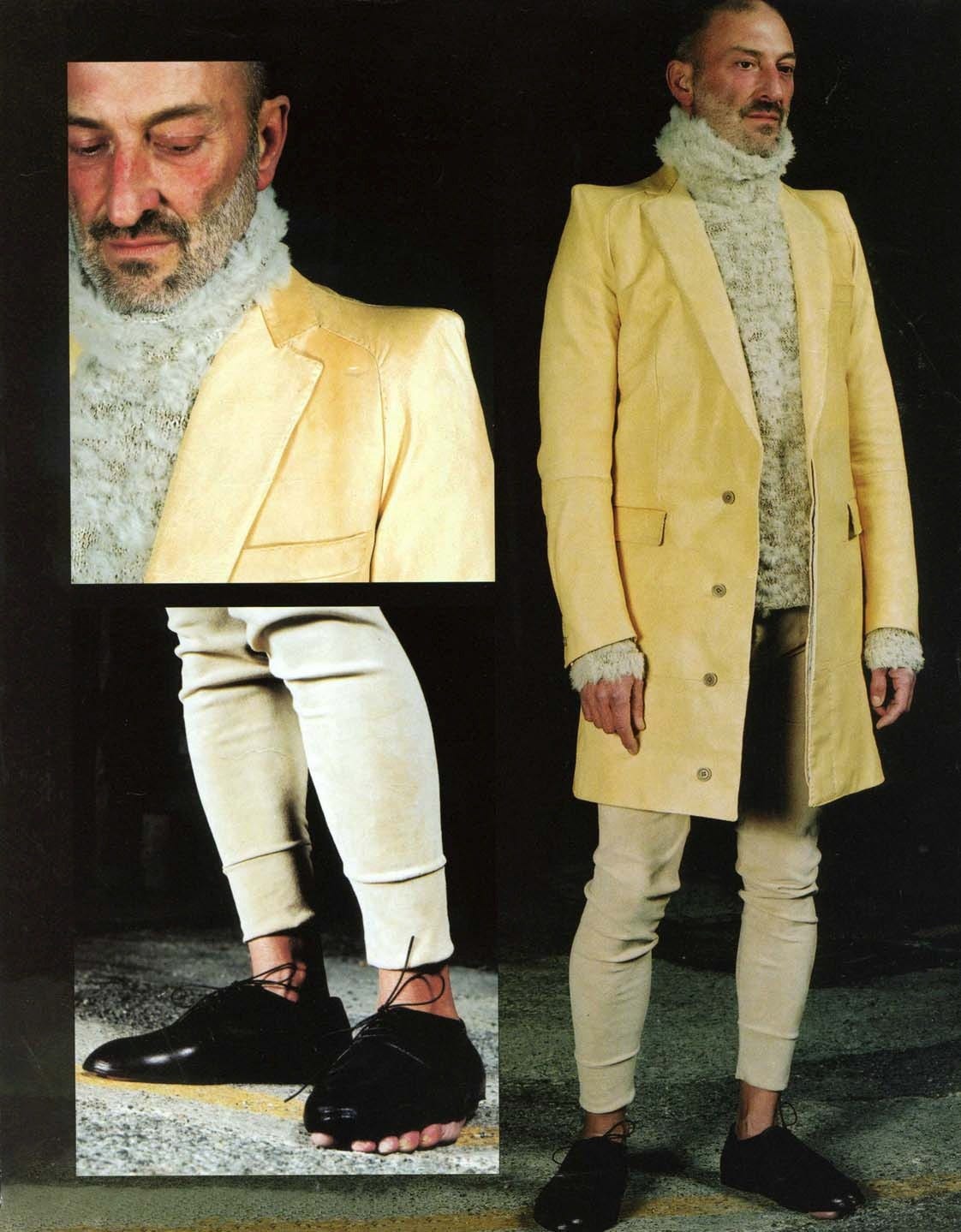
Ever since first seeing this image, I have been deeply fascinated with it. The images are promotional shots of some sort from Austrian (by way of Italy) designer, Carol Christian Poell, from his Autumn Winter 2000-01 season. I did not know it when I initially encountered the image, but the name given to the season is PURE/IMPURE.
I find that there is a level of engagement with clothing that perhaps is harder to consider critically; to really go deep into an outfit that you perhaps merely think “is fucking dope” might feel somewhat as futile a gesture as trying to critically consider why you find yourself physically attracted to someone. Whether there is cultural conditioning or not, the inherent frisson of attraction is often past the point of language. This is great! It feels, almost, sovereign. This feeds Bataille’s ideas on erotism, of course, but that’s not the point today.
There is something about the presentation of this outfit that to me reads specifically as Bataillean. My last missive here was somewhat tongue-in-cheek titled “The Bataillean Body,” but this is, perhaps, a direct expansion of some of that thought. No one I have shown this image to has felt the same response as I have. Generally, they point to an individual item of clothing while rejecting another. There is no push towards an underlying (and for me, insistent) totality in the outfit.
…
While it is perhaps just a small detail, the most insistent signifier we can encounter here is the sole-less shoes. Without much thought, perhaps we think this seems useless. non-functional. This is somewhat of a misnomer though. The human foot itself, in relationship with the rest of the skeletal system and the way we load into our legs, is actually better equipped for interacting with the ground barefoot than any potential shoe could be. The sole of a shoe most often functions are protection from the developed world, it does not actually serve our musculoskeletal system. So perhaps it’s not as useless as we thought? Clothing is ultimately dressing before it is “protection.” A garment’s utility should not be synonymous with the potential for function.
But even beyond this, the “shoe,” the depiction of the toes immediately made me think of Bataille’s essay “The Big Toe,” a quote from which opens us up above. Bataille engaged irregularly with the concept of animality through his entire oeuvre. Later it would serve his ideas of continuity, but here it postures a hierarchical insistence of man: it introduces his idea of base materialism. “Human life entails, in fact, the rage of seeing oneself as a back and forth movement from refuse to the ideal, and from the ideal to refuse -- a rage that is easily directed against an organ as base as the foot.” (ibid.) From the ideal to refuse; Pure to impure.
There is more than meets the eye regarding material here as well. The “full-length briefs” are early made of stretch velvet (a cotton/lycra blend)*. A hearty decadence; velvet upon flesh. The body wrapped as candy. Elasticity is a quality inherent to human skin; not to velvet itself. Alchemical tradition posits As Above, So Below: an echo, or a leveling? A continuity? This is an idea. There’s a sensual element here too. Would you like to wrap your legs in the skin of another?
The high neck knitwear, on the other hand, is made of very thin stripes of ageing rabbit fur.* The finish echoes the mottled wings of a bird, too young to propel himself into the air. The dream of flight is corrupted by the reality—this is not the mottled of wings, but rather the discarded fur of someone’s dinner. From idealism to refuse. Man as beast, as animal. An impossible dream. The long blazer (shammy nappa leather) gives a nod towards the propriety of man. Classic tailoring. Piqued shoulders. Poell is regularly regarded as having skills that align with the tailors of Savile Row. Proper. In this man’s dress this propriety becomes insistent against ridicule. The secret to any outfit that is unique lies exclusively in the confidence of the wearer. Man himself assuming a mask: opacity tunneling towards the core in a way that nudity never can.
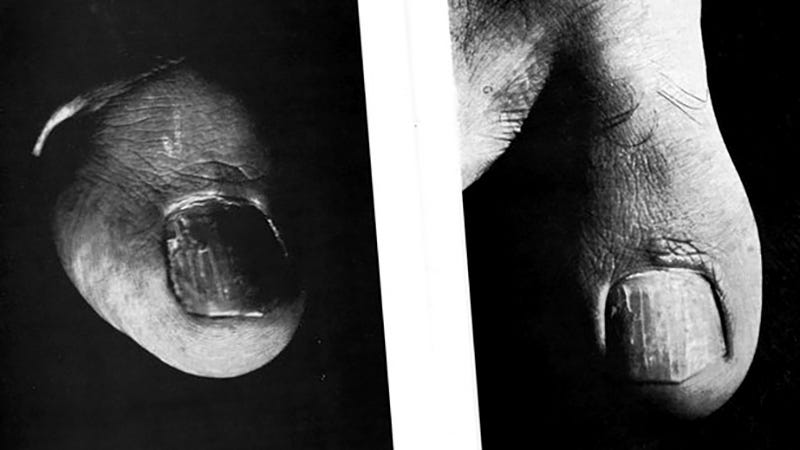
And we can’t, I would insist, make mention of Bataille’s base materialism without taking a dip into the essential texture of sexual perversity.
Man's secret horror of his foot is one of the explanations for the tendency to conceal its length and form as much as possible. Heels of greater or lesser height, depending on the sex, distract from the foot's low and flat character.
Besides, this uneasiness is often confused with a sexual uneasiness; this is especially striking among the Chinese, who, after having atrophied the feet of women, situate them at the most excessive point of deviance. [...] The same aberration is found among the Turks (Volga Turks, Turks of Central Asia), who consider it immoral to show their nude feet and who even go to bed in stockings.
Nothing similar can be cited from classical antiquity [...] On the other hand, modesty concerning the feet developed excessively in the modern era and only started to disappear in the nineteenth century. (ibid.)
Taboo exists only when something provides a perverse level of excitement when it is not permitted. There is inherently something sexually perverse about this CCP image, impossibly, in how there is barely more than an ankle, a hint of toes, and a face on display. A pure sense of animality despite the flesh being hidden. Start Kendall, in an essay on Bataille’s use of pseudonyms over his publication history, brings up the idea that, often, to obscure is to reveal something deeper. Dress as “mere costume” is not something to be taken lightly. A metaphysics of, of what precisely? Elevation? Base materialism? Or the tension itself?
*A note of appreciation to Sergio Simone of CCP SRL for clarifying these materials for me. I have slightly edited my reading based on the information I was provided.
Some housekeeping notes: I am still making my way around SubStack. I’m not editing much at this point. If I collect these pieces for more formal publication they will likely be cleaned up and expanded. There very well might be typos that I do or don’t catch and fix. I appreciate any continued support. You can find my parallel explorations primarily by way of images via my instagram, instagram.com/corpstext.