
AN ODE TO WHITE LEATHER

“You know, I had a friend who took me to a leather bar back in 1961 or ‘62. I didn’t know anything about it. But these people were the real thing–they were the real fetishists. There were a few young guys but most of them were older. I remember this very tall, angular man who was bald, and he was dressed in white leather. It was filthy. You could tell that he lived in it, you know?” –Nancy Grossman in conversation with Yvonne Rainer
I have been thinking about this quote since I first encountered it, nearly a week ago. On Friday morning I woke up at 4am and was wide awake until nearly 6am, my brain endlessly turning over, my body incapable of falling back asleep, sweating, and one of the points I couldn’t escape was this particular image, this presentation of an idea. Image as thought as aura.

There is not an abundance of photographic evidence of the gay male leather scene circa the early 60s. There is not an abundance of photographic evidence of gay life at all pre-Stonewall, but especially of gay leather culture. There is something inaccessible about pre-liberation leather culture; something immensely beyond what we can assume one has access to today. William Carney’s novels are perhaps the best access one might have; in fact his most well known novel is titled The Real Thing, a phrase Grossman uses in her account. The Rose Exterminator is my novel of choice (though I’ve yet to have the opportunity to read his A Year in a Closet). Carney’s published work consists exclusively of pre-liberation SM novels, and this work has provided a glimpse into something otherwise fully unavailable. The retrospective approach (and endless discussions of Old Guard vs New Guard) didn’t become de rigeur until after AIDS, and more specifically when leather was shifting towards a sort of reactive punk moment, a pointing towards nihilism, the aesthetic signifiers of a post-apocalyptic barbarian culture of a world without end rather than any sort of mythic cult of complicated ritual practices of communion.
But, always, the impossibility is what calls to me, an inaccessible otherness that, quantifiable, exists or existed as a state of being, elsewhere, apart from any sort of understanding. A zone away from everything. But, even here, in this impossible absence, there is something else: the idea of white leather.
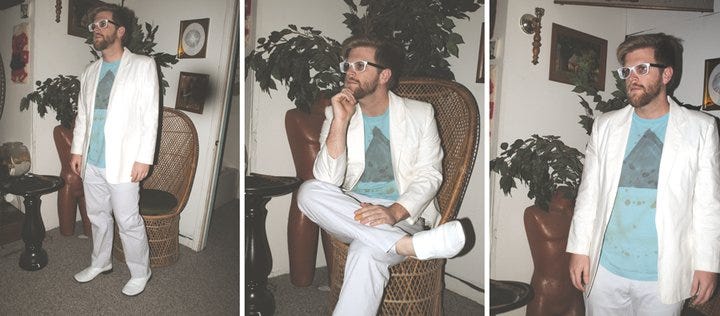
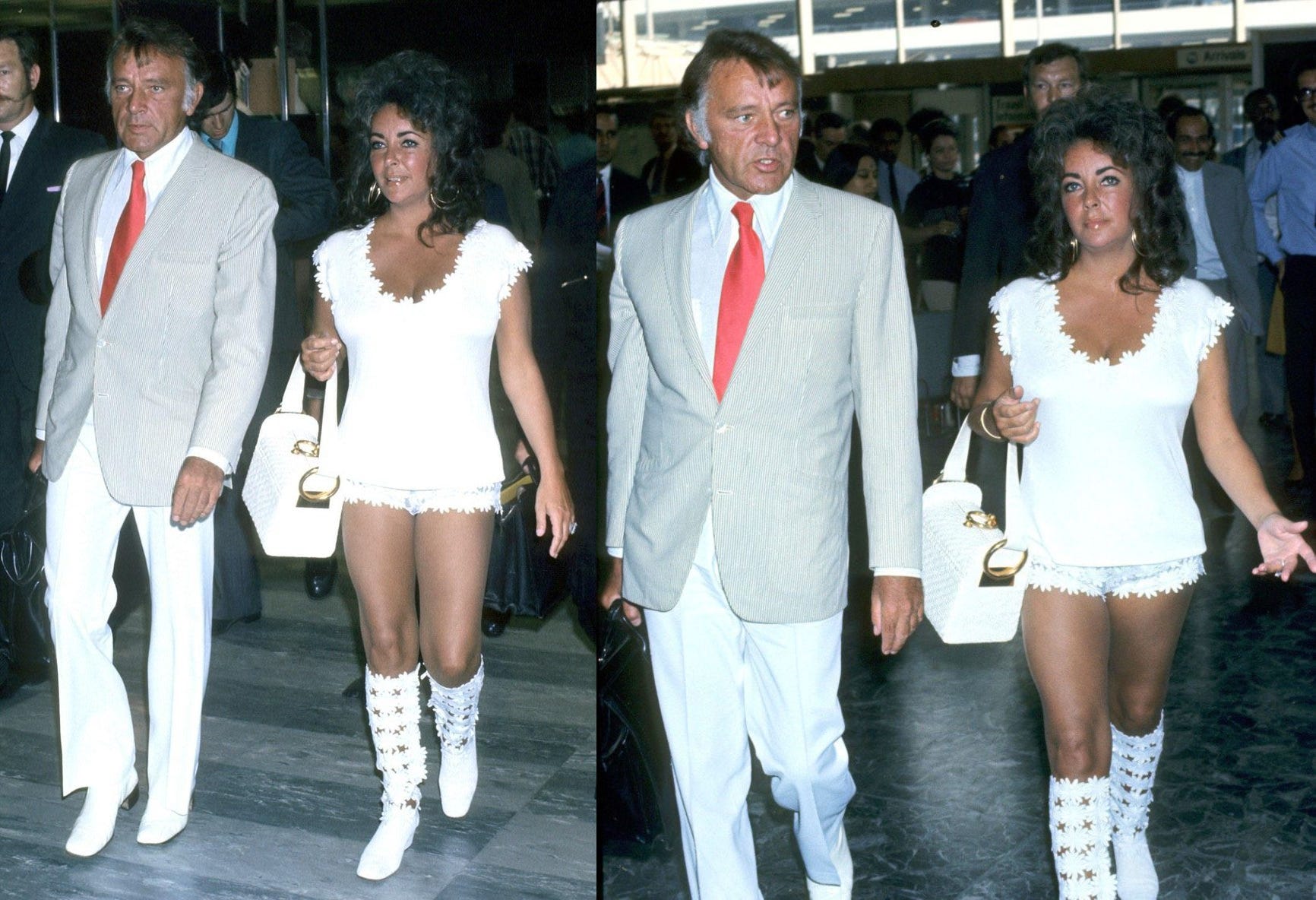
I have had an aesthetic attraction towards white leather for longer than I can remember; though I cannot remember the primal scene, or even if I ever saw an individual wearing white leather in a way that appealed to me. It has always resonated more as idea. The only reference I can recall is a photograph of Richard Burton and Elizabeth Taylor in an airport, Burton wearing a white suit, his skin tan: I wrote a poem that I can find no evidence of called Tan Richard Burton’s Suit that I read out loud in a bar in Chicago. (I would love to find this poem again; I spent several hours one night digging through my harddrive and emails with no luck). [Note: the photo has been found and can be seen below— Burton’s wearing a grey jacket,but his boots, pants, and shirt are indeed all white.] As a young 20-something I managed to get a pair of (likely PU) white leather loafers that I thought were fabulous that I would wear with an approximation of a white suit when drinking.
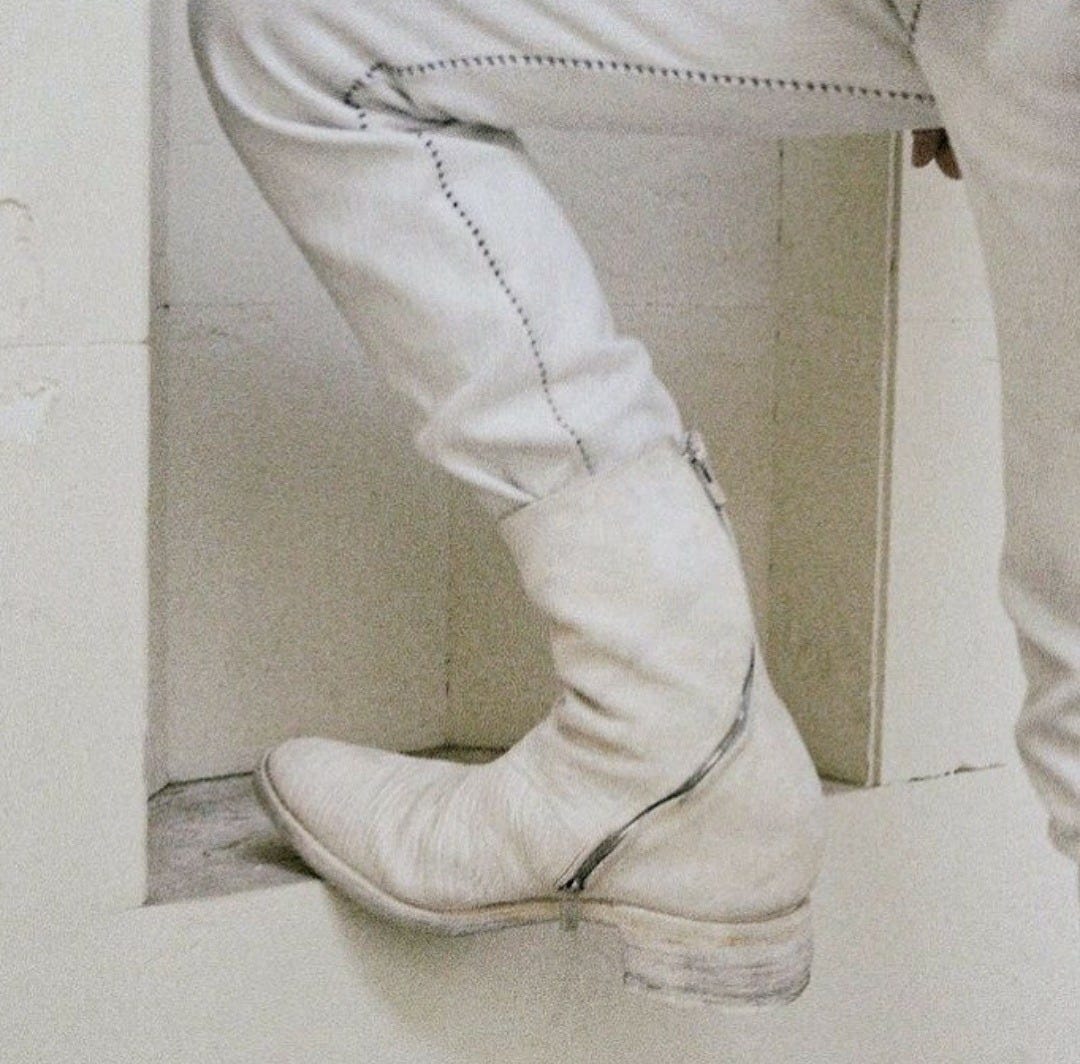
While I was certainly aware of leather culture at this age, it was absent beyond my (mostly literary) interest in transgressive sex; I was very aware of and conceptually intrigued by BDSM practices but I had no specific attachment to leather itself, especially at the fetishistic level I have today. The development of my interest in leather attached to leathersex culture (rather than designer clothing or couture) might point to why I don’t have much of a taste for sleek & clean leather. I like the animality of hides where you can really see that this material was once flesh; I like leather that looks filthy, that shows the patina of age and materiality. The very first thing that attracted me to Carol Christian Poell’s work was the specific look of his white & off white leather – I read it described on a forum as dirty white and again, an unrooted resonance sparked. While they were not my truly first pieces from Poell, my CORS (horse leather from the fore-body of the animal) leather tornado boots in col01 (affectionately called my “gogo boots” by my partner) and my CUBS (the reverse, callused side of a horse hide) vest bag in col01 were the first major pieces I put effort (and money!) into acquiring; both which I still wear regularly to this day.
Poell is one of the few designers that uses white leather in a way that, to me, really understands the potentiality of white leather; and despite my propensity to be endlessly verbose in extrapolating even the most banal minutiae of my aesthetic values, I’m not sure I want to try to push this thought further at this point—it is enough to exist as insistence: merely looking at the work reveals something that can only otherwise be found amongst very filthy vintage garments in white leather, and even this is rare. There is something inherently impossible about the materiality present in Poell’s “white leathers” – something that seems to move beyond pure aesthetic bent and towards a “pure” animality. The literal livingness of leather and the resultant way in which Poell’s tannage & dyeing process allows for the color to shift and change and react to the world at large has recolored my idea of what “white” as a color means on garments; most think of white as an insistent “optical” flat field, but it becomes much more interesting when a range, a spectrum opens up (truly the perfect echo of the cultural obsession with black clothing).
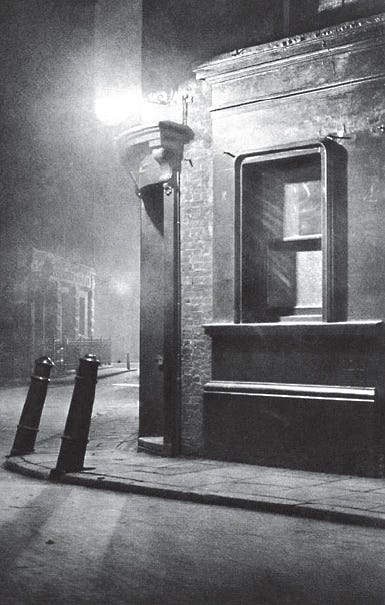
Signs circulate endlessly: engagement with Robbe-Grillet’s narrative works of the 70s combined with my own unchecked narrative fantasies find me attached to medfet as another route to fantasy: the shocking white of a doctor’s labcoat; the precise, clean sheets of an operating room. Blanchot points to white as the color of the night rather than black. An essay by Roger Laporte translated by Marshall Olds in an issue of Substance from 1976 first brought this to my attention: “Night, white night–such is the disaster, this night from which darkness is missing, without being illumined by light.” …this night from which darkness is missing… always an absence. White also as this absence brought about by light, reflection, exposure: in the photographic process, blowing out the image with light hides more than the depths of shadows in the material evidence of the negative.
Elsewhere: generally white leather is assigned to women, on men it insists upon an otherness, an alterity, perhaps, specifically, this Blanchotian night? Insisted as flamboyant; once someone insisted to me, in all earnestness, that “black [clothing] is more masculine.” The other side of the mirror there would be an insistence that white clothing is more feminine then, n’est-ce pas? Black leather is certainly sexy and pushes an idea of a ‘default’ status wherein the materiality takes precedence, but this bypasses the reality that black leather itself is dyed: the flesh is flesh. Black, here, is only an obfuscation of corporeality. Skin as shell rather than metonym.
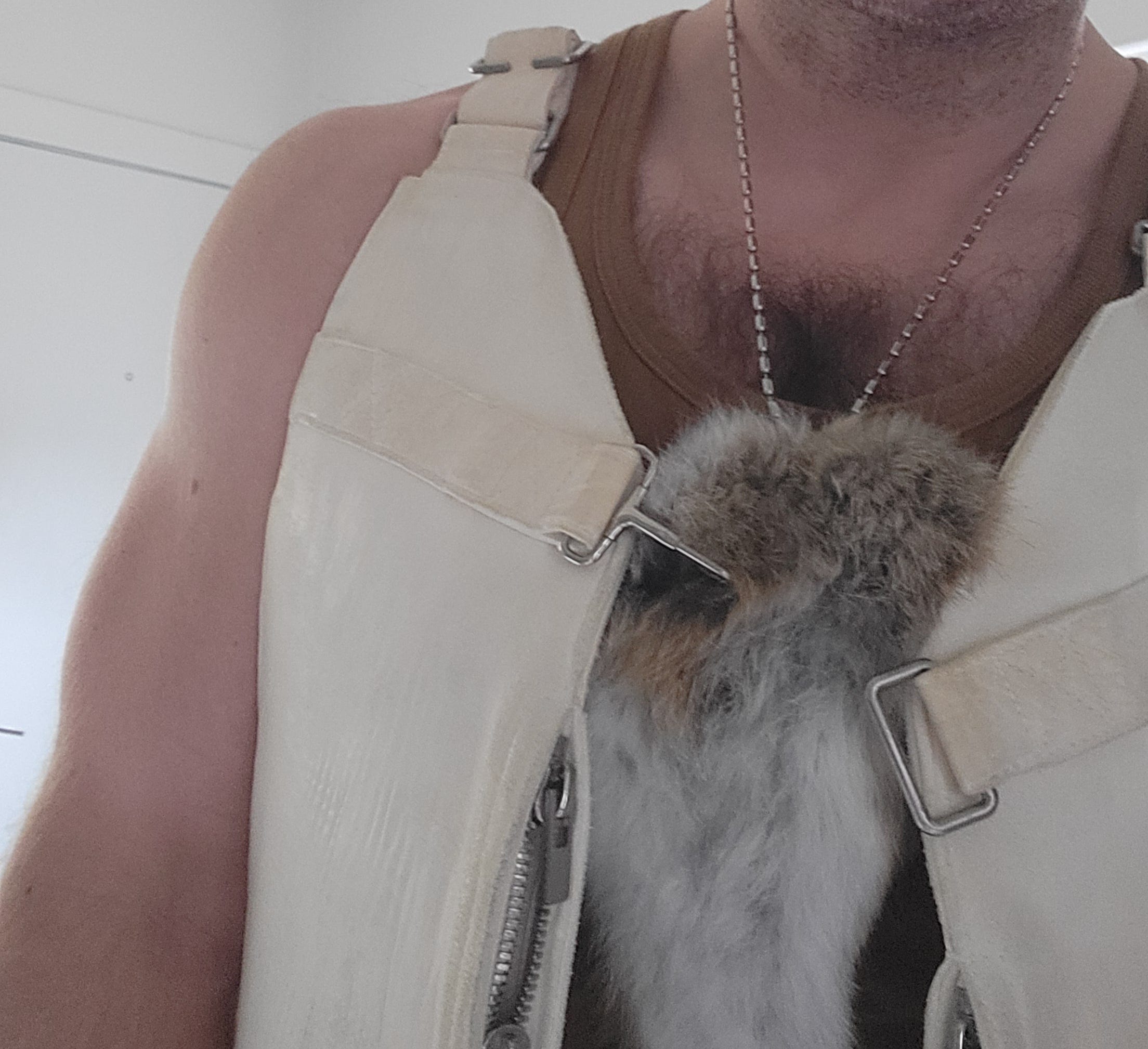
For me the potentiality of white leather is a specific sort of pleasure that is my own, rather than an inherited pleasure echoing the semantics of others. As such, I wanted to allow myself to sit in the moment of pleasure, to articulate something about it, to point to it in a way that lets it become sovereign, a sovereign nothingness.